Categories for Books, films and TV

Youthful Folly

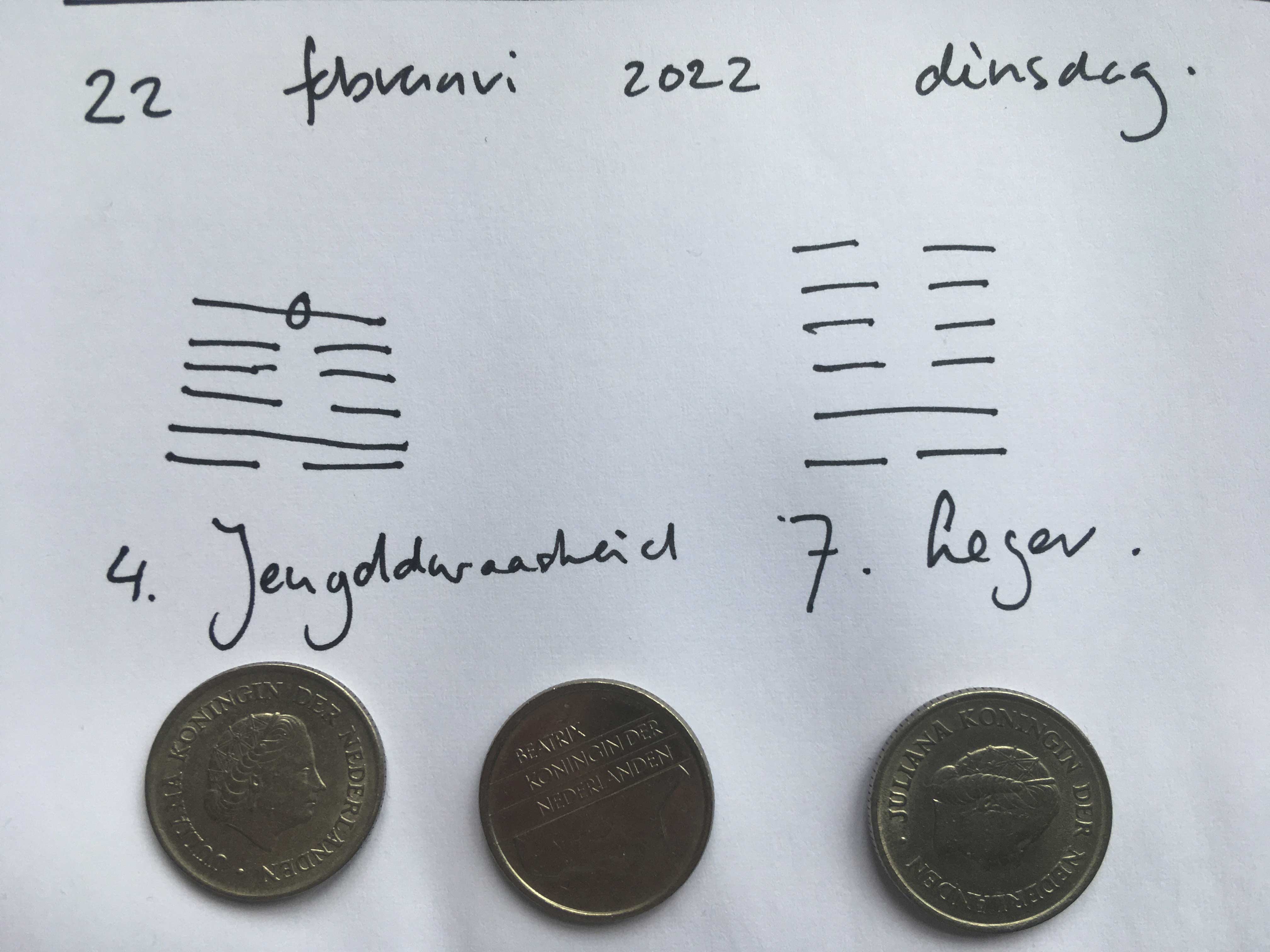
4. Mêng / Youthful Folly

above KêN KEEPING STILL, MOUNTAIN
below K’AN THE ABYSMAL, WATER

In this hexagram we are reminded of youth and folly in two different ways. The image of the upper trigram, Kên, is the mountain, that of the lower, K’an, is water; the spring rising at the foot of the mountain is the image of inexperienced youth. Keeping still is the attribute of the upper trigram; that of the lower is the abyss, danger. Stopping in perplexity on the brink of a dangerous abyss is a symbol of the folly of youth. However, the two trigrams also show the way of overcoming the follies of youth. Water is something that of necessity flows on. When the spring gushes forth, it does not know at first where it will go. But its steady flow fills up the deep place blocking its progress, and success is attained.

THE JUDGMENT

YOUTHFUL FOLLY has success.
It is not I who seek the young fool;
The young fool seeks me.
At the first oracle I inform him.
If he asks two or three times, it is importunity.
If he importunes, I give him no information.
Perseverance furthers.

In the time of youth, folly is not an evil. One may succeed in spite of it, provided one finds an experienced teacher and has the right attitude toward him. This means, first of all, that the youth himself must be conscious of his lack of experience and must seek out the teacher. Without this modesty and this interest there is no guarantee that he has the necessary receptivity, which should express itself in respectful acceptance of the teacher. This is the reason why the teacher must wait to be sought outinstead of offering himself. Only thus can the instruction take place at the right time and in the right way.
A teacher’s answer to the question of a pupil ought to be clear and definite like that expected from an oracle; thereupon it ought to be accepted as a key for resolution of doubts and a basis for decision. If mistrustful or unintelligent questioning is kept up, it serves only to annoy the teacher. He does well to ignore it in silence, just as the oracle gives one answer only and refuses to be tempted by questions implying doubt.
Given addition a perseverance that never slackens until the points are mastered one by one, real success is sure to follow. Thus the hexagram counsels the teacher as well as the pupil.

THE IMAGE

A spring wells up at the foot of the mountain:
The image of YOUTH.
Thus the superior man fosters his character
By thoroughness in all that he does.

A spring succeeds in flowing on and escapes stagnation by filling up all the hollow places in its path. In the same way character is developed by thoroughness that skips nothing but, like water, gradually and steadily fills up all gaps and so flows onward.

Nine at the top means:
In punishing folly
It does not further one
To commit transgressions.
The only thing that furthers
Is to prevent transgressions.

Sometimes an incorrigible fool must be punished. He who will not heed will be made to feel. This punishment is quite different from a preliminary shaking up. But the penalty should not be imposed in anger; it must be restricted to an objective guarding against unjustified excesses. Punishment is never an end in itself but serves merely to restore order.
This applies not only in regard to education but also in regard to the measures taken by a government against a populace guilty of transgressions. Governmental interference should always be merely preventive and should have as its sole aim the establishment of public security and peace.

7. Shih / The Army

above K’UN THE RECEPTIVE, EARTH
below K’AN THE ABYSMAL, WATER

This hexagram is made up of the trigrams K’an, water, and K’un, earth, and thus it symbolizes the ground water stored up in the earth. In the same way military strength is stored up in the mass of the people–invisible in times of peace but always ready for use as a source of power. The attributes of the two trigrams are danger inside and obedience must prevail outside.
Of the individual lines, the one that controls the hexagram is the strong nine in the second place, to which the other lines, all yielding, are subordinate. This line indicates a commander, because it stands in the middle of one of the two trigrams. But since it is in the lower rather than the upper trigram, it represents not the ruler but the efficient general, who maintains obedience in the army by his authority.

THE JUDGMENT

THE ARMY. The army needs perseverance
And a strong man.
Good fortune without blame.

An army is a mass that needs organization in order to become a fighting force. Without strict discipline nothing can be accomplished, but this discipline must not be achieved by force. It requires a strong man who captures the hearts of the people and awakens their enthusiasm. In order that he may develop his abilities he needs the complete confidence of his ruler, who must entrust him with full responsibility as long as the war lasts. But war is always a dangerous thing and brings with it destruction and devastation. Therefore it should not be resorted to rashly but, like a poisonous drug, should be used as a last recourse.

THE IMAGE

In the middle of the earth is water:
The image of THE ARMY.
Thus the superior man increases his masses
By generosity toward the people.

Ground water is invisibly present within the earth. In the same way the military power of a people is invisibly present in the masses. When danger threatens, every peasant becomes present in the masses. When danger threatens, every peasant becomes a soldier; when the war ends, he goes back to his plow. He who is generous toward the people wins their love, and a people living under a mild rule becomes strong and powerful. Only a people
economically strong can be important in military power. Such power must therefore be cultivated by improving the economic condition of the people and by humane government. Only when there is this invisible bond between government and people, so that the people are sheltered by their government as ground water is sheltered by the earth, is it possible to wage a victorious war.
Published on February 23, 2022 at 6:00 by

76. Hardness

Living people
are soft and tender.
Corpses are hard and stiff.
The ten thousand things,
the living grass, the trees,
are soft, pliant.
Dead, they’re dry and brittle.

So hardness and stiffness
go with death;
tenderness, softness,
go with life.

And the hard sword fails,
the stiff tree’s felled.
The hard and great go under.
The soft and weak stay up.1

Source: Tao Te Ching, Lao Tzu
Translated by Ursula K. Le Guin


1 In an age when hardness is supposed to be the essence of strength, and even the beauty of women is reduced nearly to the bone, I welcome this reminder that tanks and tombstones are not very adequate role models, and that to be alive is to be vulnerable. (Footnote by Ursula Le Guin)

Published on February 17, 2022 at 6:00 by

75. Greed

People are starving.
The rich gobble taxes,
that’s why people are starving.

People rebel.
The rich oppress them,
that’s why people rebel.

People hold life cheap.
The rich make it too costly,
that’s why people hold it cheap.

But those who don’t live for the sake of living
are worth more than the wealth-seekers.

Source: Tao Te Ching, Lao Tzu
Translated by Ursula K. Le Guin

Published on February 8, 2022 at 6:00 by

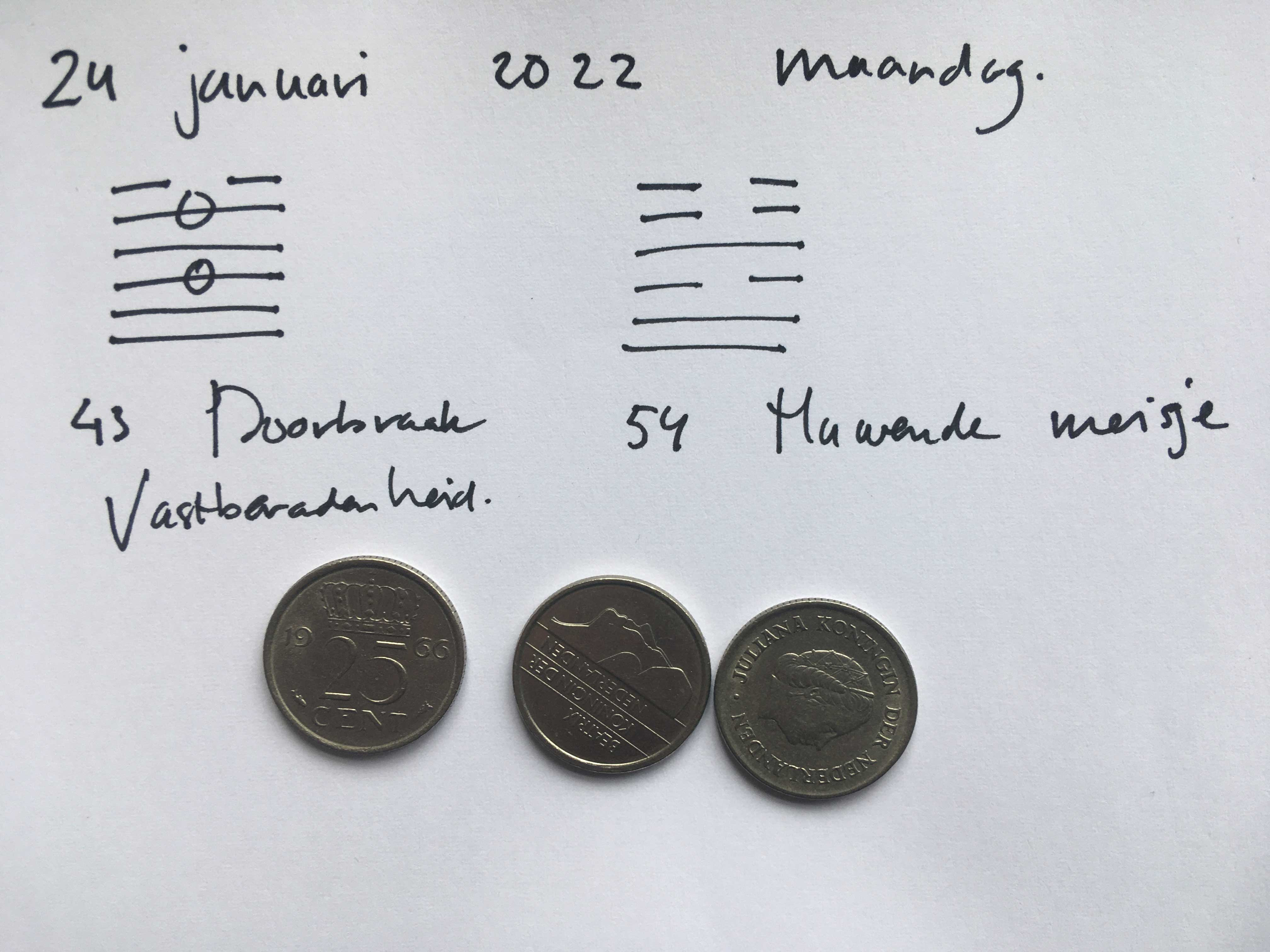
43. Kuai / Break-through

43. Kuai / Break-through (Resoluteness)

above TUI THE JOYOUS, LAKE
below CH’IEN THE CREATIVE, HEAVEN

This hexagram signifies on the one hand a break-through after a long accumulation of tension, as a swollen river breaks through its dikes, or in the manner of a cloudburst. On the other hand, applied to human conditions, it refers to the time when inferior people gradually begin to disappear. Their influence is on the wane; as a result of resolute action, a change in conditions occurs, a break-through. The hexagram is linked with the third month [April-May].

THE JUDGMENT

BREAK-THROUGH. One must resolutely make the matter known
At the court of the king.
It must be announced truthfully. Danger.
It is necessary to notify one’s own city.
It does not further to resort to arms.
It furthers one to undertake something.

Even if only one inferior man is occupying a ruling position in a city, he is able to oppress superior men. Even a single passion still lurking in the heart has power to obscure reason. Passion and reason cannot exist side by side-therefore fight without quarter is necessary if the good is to prevail.
In a resolute struggle of the good against evil, there are, however, definite rules that must not be disregarded, if it is to succeed. First, resolution must be based on a union of strength and friendliness. Second, a compromise with evil is not possible; evil must under all circumstances be openly discredited. Nor must our own passions and shortcomings be glossed over. Third, the struggle must not be carried on directly by force. If evil is branded, it thinks of weapons, and if we do it the favor of fighting against it blow for blow, we lose in the end because thus we ourselves get entangled in hatred and passion. Therefore it is important to begin at home, to be on guard in our own persons against the faults we have branded. In this way, finding no opponent, the sharp edges of the weapons of evil becomes dulled. For the same reasons we should not combat our own faults directly. As long as we wrestle with them, they continue victorious. Finally, the best way to fight evil is to make energetic progress in the good.

THE IMAGE

The lake has risen up to heaven:
The image of BREAK-THROUGH.
Thus the superior man
Dispenses riches downward
And refrains from resting on his virtue.

When the water of a lake has risen up to heaven, there is reason to fear a cloudburst. Taking this as a warning, the superior man forestalls a violent collapse. If a man were to pile up riches for himself alone, without considering others, he would certainly experience a collapse. If a man were to pile up riches for himself alone, without considering others, he would certainly experience a collapse. For all gathering is followed by dispersion. Therefore the superior man begins to distribute while he is accumulating. In the same way, in developing his character he takes care not to become hardened in obstinacy but to remain receptive to impressions by help of strict and continuous self-examination.

Nine in the third place means:
To be powerful in the cheekbones
Brings misfortune.
The superior man is firmly resolved.
He walks alone and is caught in the rain.
He is bespattered,
And people murmur against him.
No blame.

Here we have a man in an ambiguous situation. While all others are engaged in a resolute fight against all that is inferior, he alone has a certain relationship with an inferior man. If he were to show strength outwardly and turn against this man before the time is ripe, he would only endanger the entire situation, because the inferior man would too quickly have recourse to countermeasures. The task of the superior man becomes extremely difficult here. He must be firmly resolved within himself and, while maintaining association with the inferior man, avoid any participation in his evilness. He will of course be misjudged. It will be thought that he belong to the party of the inferior man. He will be lonely because no one will understand him. His relations with the inferior man will sully him in the eyes of the multitude, and they will turn against him, grumbling. But he can endure this lack of appreciation and makes no mistake, because he remains true to himself.

° Nine in the fifth place means:
In dealing with weeds,
Firm resolution is necessary.
Walking in the middle
Remains free of blame.

Weeds always grow back again and are difficult to exterminate. So too the struggle against an inferior man in a high position demands firm resolution. One has certain relations with him, hence there is danger that one may give up the struggle as hopeless. But this must not be. One must go on resolutely and not allow himself to be deflected from him course. Only in this way does one remain free of blame.

54. Kuei Mei / The Marrying Maiden

above CHêN THE AROUSING, THUNDER
below TUI THE JOYOUS, LAKE

Above we have Chên, the eldest son, and below, Tui, the youngest daughter. The man leads and the girl follows him in gladness. The picture is that of the entrance of the girl into her husband’s house. In all, there are four hexagrams depicting the relationship between husband and wife. Hsien, INFLUENCE, (31), describes the attraction that a young couple have for each other; Hêng, DURATION (32), portrays the permanent relationships of marriage; Chien, DEVELOPMENT (53), reflects the protracted, ceremonious procedures attending THE MARRYING MAIDEN, shows a young girl under the guidance of an older man who marries her.

THE JUDGMENT

THE MARRYING MAIDEN.
Undertakings bring misfortune.
Nothing that would further.

A girl who is taken into the family, but not as the chief wife, must behave with special caution and reserve. She must not take it upon herself to supplant the mistress of the house, for that would mean disorder and lead to untenable relationships.
The same is true of all voluntary relationships between human beings. While legally regulated relationships based on personal inclination depend in the long run entirely on tactful reserve.
Affection as the essential principle of relatedness is of the greatest importance in all relationships in the world. For the union of heaven and earth is the origin of the whole of nature. Among human beings likewise, spontaneous affection is the all-inclusive principle of union.

THE IMAGE

Thunder over the lake:
The image of THE MARRYING MAIDEN.
Thus the superior man
Understands the transitory
In the light of the eternity of the end.

Thunder stirs the water of the lake, which follows it in shimmering waves. This symbolizes the girl who follows the man of her choice. But every relationship between individuals bears within it the danger that wrong turns may be taken, leading to endless misunderstandings and disagreements. Therefore it is necessary constantly to remain mindful of the end. If we permit ourselves to drift along, we come together and are parted again as the day may determine. If on the other hand a man fixes his mind on an end that endures, he will succeed in avoiding the reefs that confront the closer relationships of people.

Published on January 25, 2022 at 6:00 by

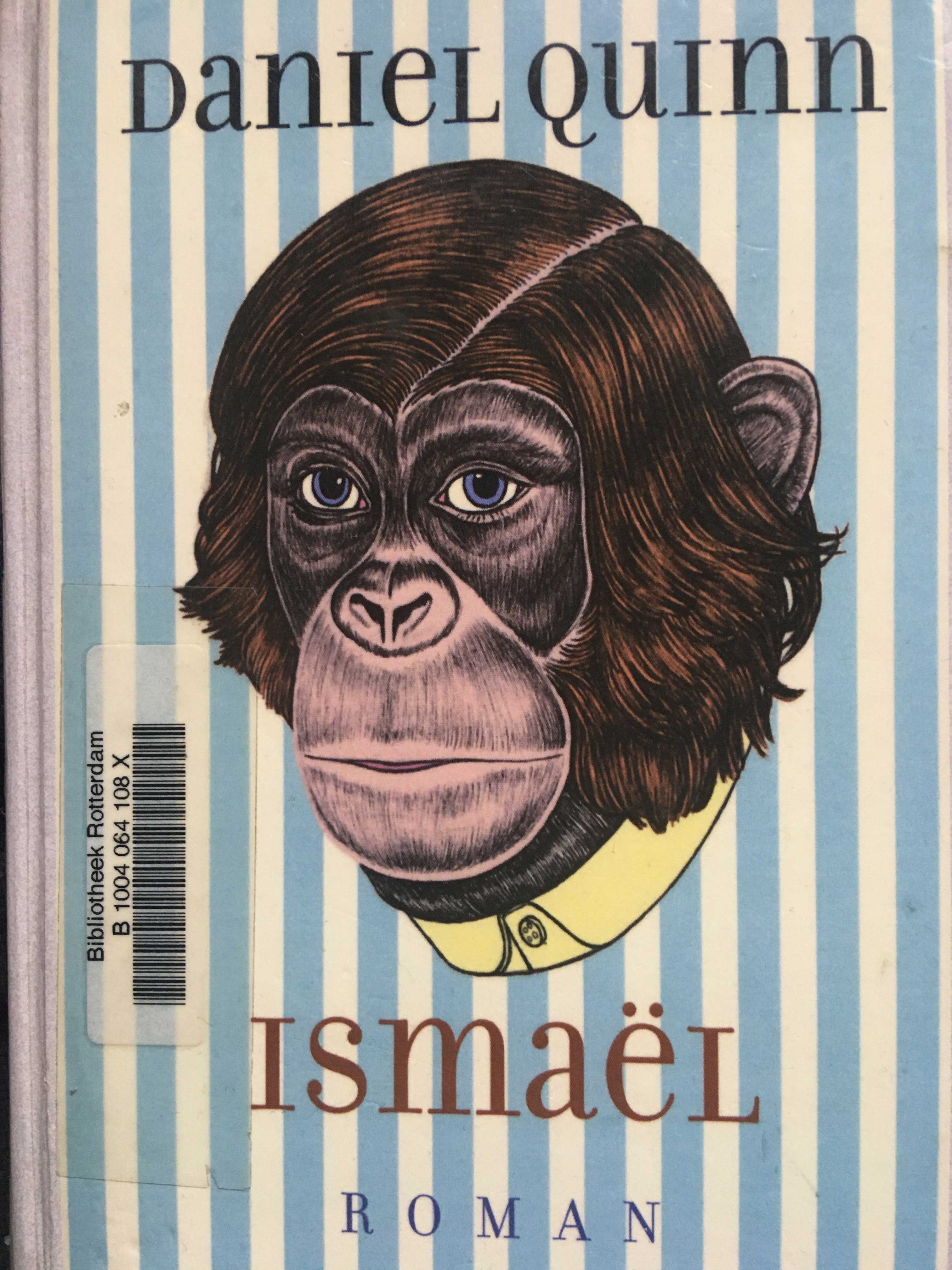
Ishmael

A few weeks ago i watched the youtube video called 3 Books that Changed My Way of Living from Kalle Flodin. I was surprised by the final and first book on the list: Ishmael written by Daniel Quinn. I remembered a friend of mine had told me about this book a couple of years ago. I even wrote it down in a booklet i kept. This time i ordered this book from the library. I read it, with pleasure and finished it within a week.

The main actors in the book are the Takers and the Leavers. Takers are the current ‘civilized’ people occurring since the agricultural revolution taking place around 10,000 years ago. Leavers are the other people, the so-called hunter-gatherers. Myths are the stories ruling the world. The man who is talking to Ishmael, the old gorilla captured and teaching the man about the world and the Takers and Leavers, doesn’t believe myths have any say over this world in which he lives – our own world. Which is of course completely untrue.

The book is written in a simple language, clear to follow. Highly recommended.

Published on December 20, 2021 at 6:00 by

14. Celebrating mystery

Look at it: nothing to see.
Call it colorless.
Listen to it: nothing to hear.
Call it soundless.
Reach for it: nothing to hold.
Call it intangible.

Triply undifferentiated,
it merges into oneness,
not bright above,
not dark below.

Never, oh! never
can it be named.
It reverts, it returns
to unbeing.
Call it the form of the unformed,
the image of no image.

Call it unthinkable thought.
Face it: no face.
Follow it: no end.

Holding fast to the old Way,
we can live in the present.
Mindful of the ancient beginnings,
we hold the thread of the Tao.

Source: Tao Te Ching, Lao Tzu
Translated by Ursula K. Le Guin

Published on December 8, 2021 at 6:00 by

The Princess and the Pea


The princess and the pea
A fairytale by Hans Christian Andersen

Once upon a time there was a prince who wanted to marry a princess; but she would have to be a real princess. He travelled all over the world to find one, but nowhere could he get what he wanted. There were princesses enough, but it was difficult to find out whether they were real ones. There was always something about them that was not as it should be. So he came home again and was sad, for he would have liked very much to have a real princess.

One evening a terrible storm came on; there was thunder and lightning, and the rain poured down in torrents. Suddenly a knocking was heard at the city gate, and the old king went to open it.

It was a princess standing out there in front of the gate. But, good gracious! what a sight the rain and the wind had made her look. The water ran down from her hair and clothes; it ran down into the toes of her shoes and out again at the heels. And yet she said that she was a real princess.

“Well, we’ll soon find that out,” thought the old queen. But she said nothing, went into the bed-room, took all the bedding off the bedstead, and laid a pea on the bottom; then she took twenty mattresses and laid them on the pea, and then twenty eider-down beds on top of the mattresses.

On this the princess had to lie all night.

In the morning she was asked how she had slept.

“Oh, very badly!” said she. “I have scarcely closed my eyes all night. Heaven only knows what was in the bed, but I was lying on something hard, so that I am black and blue all over my body. It’s horrible!”

Now they knew that she was a real princess because she had felt the pea right through the twenty mattresses and the twenty eider-down beds. Nobody but a real princess could be as sensitive as that.

So the prince took her for his wife, for now he knew that he had a real princess; and the pea was put in the museum, where it may still be seen, if no one has stolen it.

There, that is a true story.

Published on December 6, 2021 at 6:00 by