Categories for General

Increase

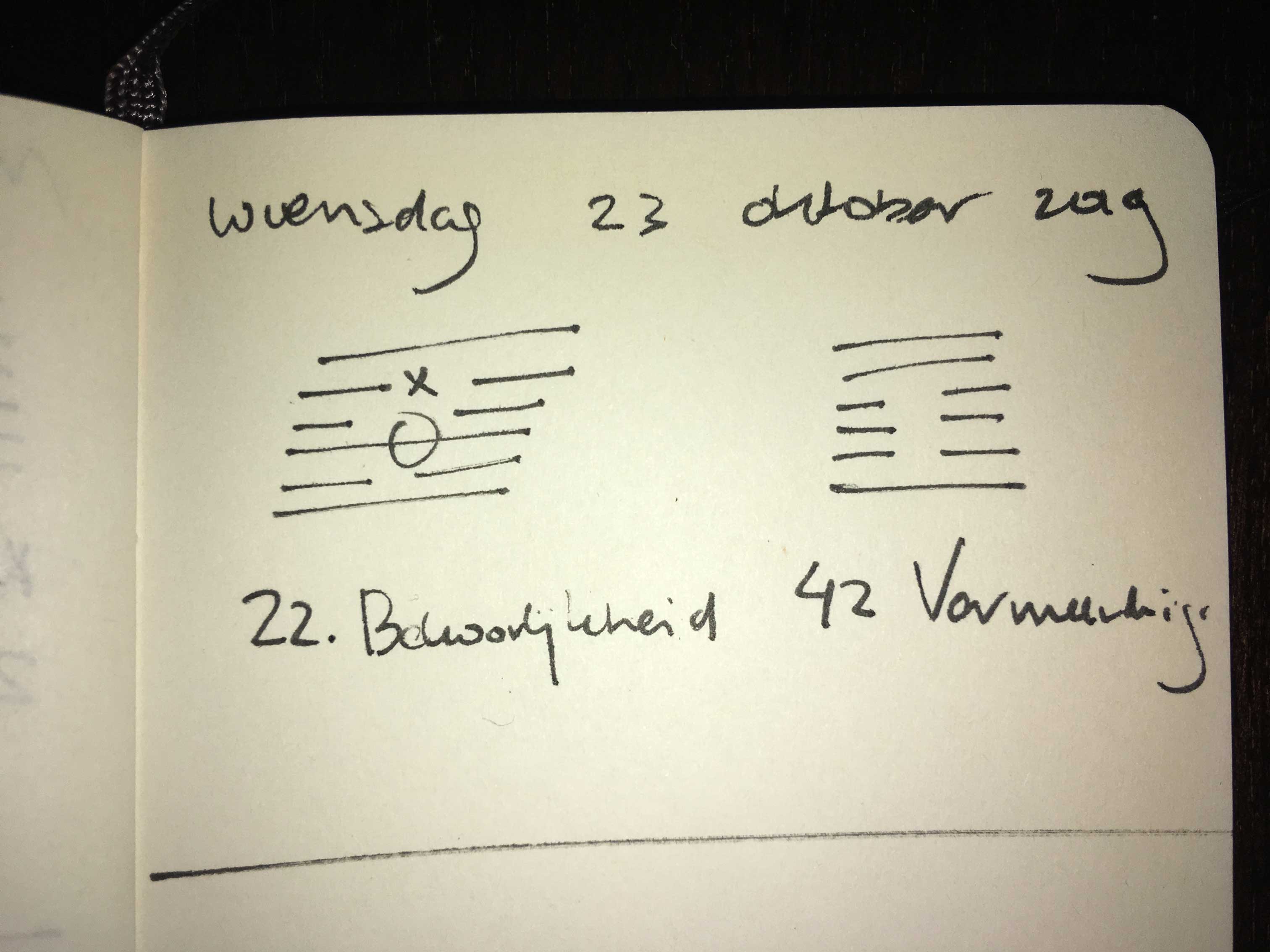
22. Pi / Grace

above KêN KEEPING STILL, MOUNTAIN
below LI THE CLINGING, FIRE

This hexagram shows a fire that breaks out of the secret depths of the earth and, blazing up, illuminates and beautifies the mountain, the heavenly heights. Grace-beauty of form-is necessary in any union if it is to be well ordered and pleasing rather than disordered and chaotic.

THE JUDGMENT

GRACE has success.
In small matters
It is favorable to undertake something.

Grace brings success. However, it is not the essential or fundamental thing; it is only the ornament and therefore be used sparingly and only in little things. In the lower trigram of fire a yielding line comes between two strong lines and makes them beautiful, but the strong lines are the essential content and the weak line is the beautifying form. In the upper trigram of the mountain, the strong line takes the lead, so that here again the strong element must be regarded as the decisive factor. In nature we see in the sky the strong light of the sun; the life of the world depends on it. But this strong, essential thing is changed and given pleasing variety by the moon and the stars. In human affairs, aesthetic form comes into being when traditions exist that, strong and abiding like mountains, are made pleasing by a lucid beauty. By contemplating the forms existing in the heavens we come to understand time and its changing demands. Through contemplation of the forms existing in human society it becomes possible to shape the world.

THE IMAGE

Fire at the foot of the mountain:
The image of GRACE.
Thus does the superior man proceed
When clearing up current affairs.
But he dare not decide controversial issues in this way.

The fire, whose light illuminates the mountain and makes it pleasing, does not shine far; in the same way, beautiful form suffices to brighten and to throw light upon matters of lesser moment, but important questions cannot be decided in this way. They require greater earnestness.

Nine in the third place means:
Graceful and moist.
Constant perseverance brings good fortune.

This represents a very charming life situation. One is under the spell of grace and the mellow mood induced by wine. This grace can adorn, but it can also swamp us. Hence the warning not to sink into convivial indolence but to remain constant in perseverance. Good fortune depends on this.

Six in the fifth place means:
Grace in the hills and gardens.
The roll of silk is meager and small.
Humiliation, but in the end good fortune.

A man withdraws from contact with people of the lowlands, who seek nothing but magnificence and luxury, in to the solitude of the heights. There he finds an individual to look up to, whom he would like to have as a friend. But the gifts he has to offer are poor and few, so that he feels ashamed. However, it is not the material gifts that count, but sincerity of feeling, and so all goes well in the end.

42. I / Increase

above SUN THE GENTLE, WIND
below CHêN THE AROUSING, THUNDER

The idea of increase is expressed in the fact that the strong lowest line of the upper trigram has sunk down and taken its place under the lower trigram. This conception also expresses the fundamental idea on which the Book of Changes is based. To rule truly is to serve.
A sacrifice of the higher element that produces an increase of the lower is called an out-and-out increase: it indicates the spirit that alone has power to help the world.

THE JUDGMENT

INCREASE. It furthers one
To undertake something.
It furthers one to cross the great water.

Sacrifice on the part of those above for the increase of those below fills the people with a sense of joy and gratitude that is extremely valuable for the flowering of the commonwealth. When people are thus devoted to their leaders, undertakings are possible, and even difficult and dangerous enterprises will succeed. Therefore in such times of progress and successful development it is necessary to work and make the best use of time. This time resembles that of the marriage of heaven and earth, when the earth partakes of the creative power of heaven, forming and bringing forth living beings. The time of INCREASE does not endure, therefore it must be utilized while it lasts.

THE IMAGE

Wind and thunder: the image of INCREASE.
Thus the superior man:
If he sees good, he imitates it;
If he has faults, he rids himself of them.

While observing how thunder and wind increase and strengthen each other, a man can not the way to self-increase and self-improvement. When he discovers good in others, he should imitate it and thus make everything on earth his own. If he perceives something bad in himself, let him rid himself of it. In this way he becomes free of evil. This ethical change represents the most important increase of personality.

Published on October 24, 2019 at 6:00 by

Nothing

Nothing much coming out of my hands today. I did go out to lunch in Spirit. I felt so tired i was lying on my bed for an hour or so. I spend some time reading. Thinking about this post.

I’m sorry.

I do hope you have a nice day. Enjoy the weekend. Salute!

Published on September 20, 2019 at 6:00 by

Opposition

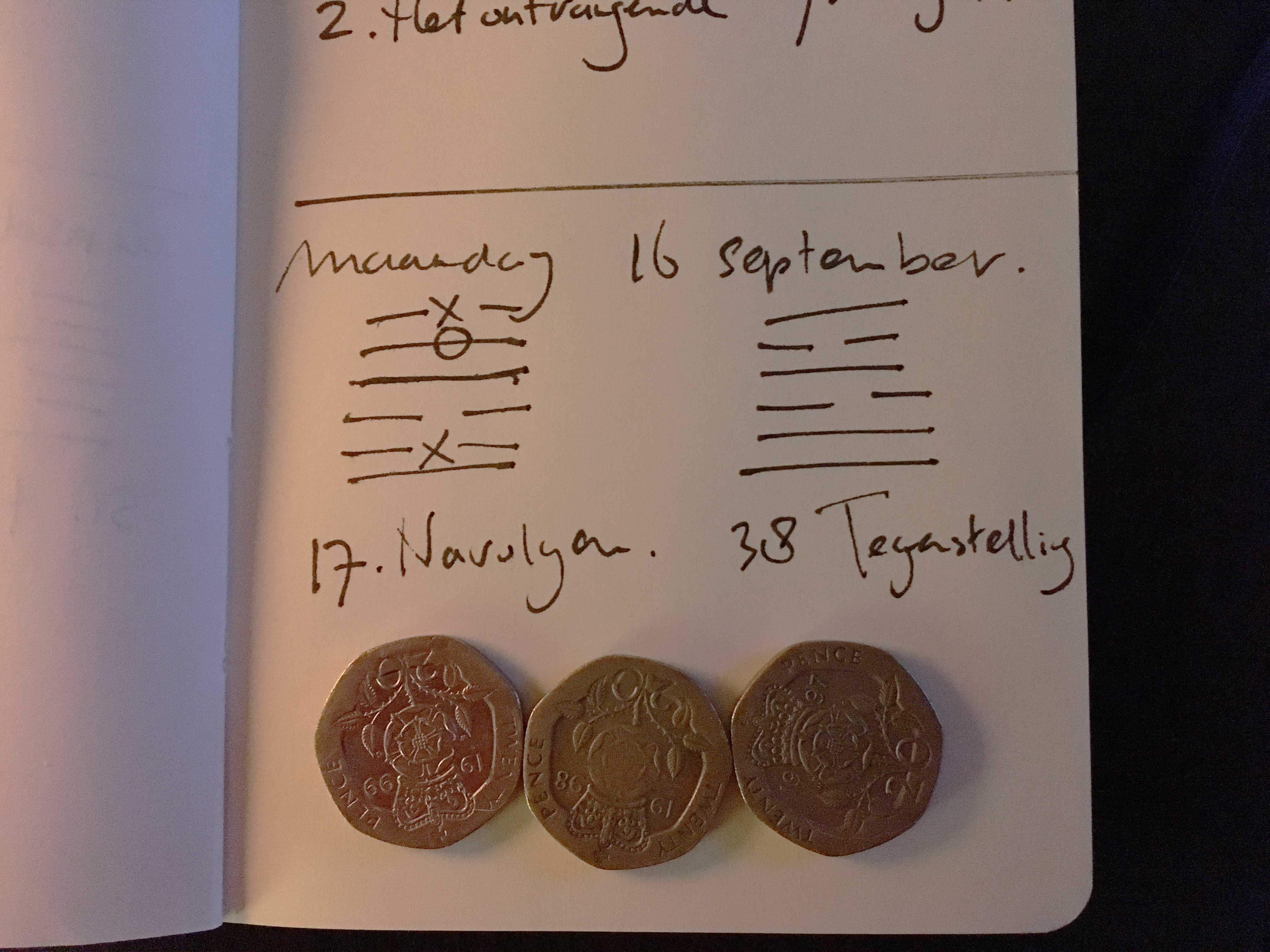
17. Sui / Following

above TUI THE JOYOUS, LAKE
below CHêN THE AROUSING, THUNDER

The trigram Tui, the Joyous, whose attribute is gladness, is above; Chên, the Arousing, which has the attribute of movement, is below. Joy in movement induces following. The Joyous is the youngest daughter, while the Arousing is the eldest son. An older man defers to a young girl and shows her consideration. By this he moves her to follow him.

THE JUDGMENT

FOLLOWING has supreme success.
Perseverance furthers. No blame.

In order to obtain a following one must first know how to adapt oneself. If a man would rule he must first learn to serve, for only in this way does he secure from those below him the joyous assent that is necessary if they are to follow him. If he has to obtain a following by force or cunning, by conspiracy or by creating faction, he invariably arouses resistance, which obstructs willing adherence. But even joyous movement can lead to evil consequences, hence the added stipulation, “Perseverance furthers” –that is, consistency in doing right– together with “No blame.” Just as we should not ask others to follow us unless this condition is fulfilled, so it is only under this condition that we can in turn follow others without coming to harm.
The thought of obtaining a following through adaptation to the demands of the time is a great and significant idea; this is why the appended judgment is so favorable.

THE IMAGE

Thunder in the middle of the lake:
The image of FOLLOWING.
Thus the superior man at nightfall
Goes indoors for rest and recuperation.

In the autumn electricity withdraws into the earth again and rests. Here it is the thunder in the middle of the lake that serves as the image–thunder in its winter rest, not thunder in motion. The idea of following in the sense of adaptation to the demands of the time grows out of this image. Thunder in the middle of the lake indicates times of darkness and rest. Similarly, a superior man, after being tirelessly active all day, allows himself rest and recuperation at night. No situation can become favorable until one is able to adapt to it and does not wear himself out with mistaken resistance.

Six in the second place means:
If one clings to the little boy,
One loses the strong man.

In friendships and close relationships an individual must make a careful choice. He surrounds himself either with good or with bad company; he cannot have both at once. If he throws himself away on unworthy friends he loses connection with people of intellectual power who could further him in the good.

°Nine in the fifth place means:
Sincere in the good. Good fortune.

Every man must have something he follows–something that serves him as a lodestar. He who follows with conviction the beautiful and the good may feel himself strengthened by this saying.

Six at the top means:
He meets with firm allegiance
And is still further bound.
The king introduces him
To the Western Mountain.

This refers to a man, an exalted sage, who has already put the turmoil of the world behind him. But a follower appears who understands him and is not to be put off. So the sage comes back into the world and aids the other in his work. Thus there develops an eternal tie between the two.
The allegory is chosen from the annals of the Chou dynasty. The rulers of this dynasty honored men who had served them well by awarding them a place in the royal family’s temple of ancestors on the Western Mountain. In this way they were regarded as sharing in the destiny of the ruling family.

38. K’uei / Opposition

above LI THE CLINGING, FLAME
below TUI THE JOYOUS, LAKE

This hexagram is composed of the trigram Li above, i.e., flame, which burns upward, and Tui below, i.e., the lake, which seeps downward. These tow movements are indirect contrast. Furthermore, LI is the second daughter and Tui the youngest daughter, and although they live in the same house they belong to different men; hence their wills are not the same but are divergently directed.

THE JUDGMENT

OPPOSITION. In small matters, good fortune.

When people live in opposition and estrangement they cannot carry out a great undertaking in common; their points of view diverge too widely. In such circumstances one should above all not proceed brusquely, for that would only increase the existing opposition; instead, one should limit oneself to producing gradual effects in small matters. Here success can still be expected, because the situation is such that the opposition does not preclude all agreement.
In general, opposition appears as an obstruction, but when it represents polarity within a comprehensive whole, it has also its useful and important functions. The oppositions of heaven and earth, spirit and nature, man and woman, when reconciled, bring about the creation and reproduction of life. In the world of visible things, the principle of opposites makes possible the differentiation by categories through which order is brought into the world.

THE IMAGE.

Above, fire; below. The lake.
The image of OPPOSITION.
Thus amid all fellowship
The superior man retains his individuality.

The two elements, fire and water, never mingle but even when in contact retain their own natures. So the sutured man is never led into baseness or vulgarity through intercourse or community of interests with persons of another sort; regardless of all commingling, he will always preserve his individuality.


Published on September 17, 2019 at 6:00 by

Getting back for a bit

The last days were difficult. I felt tired. I expected Muis to turn around every corner in my house. I still do. I’m cleaning up his stuff. I will not get a new cat, not until i have a house with a garden. Someday sometime. Perhaps.

I will be fine. It takes a little time.

Cheers. *smile*

Published on September 4, 2019 at 6:00 by

A silent day

A day i took care of my cat. A day i went out and got me a pistolet beef and tapenade at the butcher. A day i brought my old children’s books, which i have never read myself, to the give away cupboard. A day i made a chicken and ratatouille dish. A day i read. A day i listened to music. A day i played wow classic. A day i watched the final of the Great British Bake Off 2014 in the rerun on television. A day i’m happy it is not so warm anymore.

Enjoy your days this weekend. Salute!

Published on August 30, 2019 at 6:00 by

The Army

2. K’un / The Receptive

above K’UN THE RECEPTIVE, EARTH
below K’UN THE RECEPTIVE, EARTH

This hexagram is made up of broken lines only. The broken lines represents the dark, yielding, receptive primal power of yin. The attribute of the hexagram is devotion; its image is the earth. It is the perfect complement of THE CREATIVE–the complement, not the opposite, for the Receptive does not combat the Creative but completes it . It represents nature in contrast to spirit, earth in contrast to heaven, space as against time, the female-maternal as against the male-paternal. However, as applied to human affairs, the principle of this complementary relationship is found not only in the relation between man and woman, but also in that between prince and minister and between father and son. Indeed, even in the individual this duality appears in the coexistence of the spiritual world and the world of the senses.
But strictly speaking there is no real dualism here, because there is a clearly defined hierarchic relationship between the two principles. In itself of course the Receptive is just as important as the Creative, but the attribute of devotion defines the place occupied by this primal power in relation to the Creative. For the Receptive must be activated and led by the Creative; then it is productive of good. Only when it abandons this position and tries to stand as an equal side by side with the Creative, does it become evil. The result then is opposition to and struggle against the Creative, which is productive of evil to both.

THE JUDGMENT

THE RECEPTIVE brings about sublime success,
Furthering through the perseverance of a mare.
If the superior man undertakes something and tries to lead,
He goes astray;
But if he follows, he finds guidance.
It is favorable to find friends in the west and south,
To forego friends in the east and north.
Quiet perseverance brings good fortune.

The four fundamental aspects of the Creative–“sublime success, furthering through perseverance”–are also attributed to the Receptive. Here, however, the perseverance is more closely defined: it is that of a mare. The Receptive connotes spatial reality in contrast to the spiritual potentiality of the Creative. The potential becomes real and the spiritual becomes spatial through a specifically qualifying definition. Thus the qualification, “of a mare,” is here added to the idea of perseverance. The horse belongs to earth just as the dragon belongs to heaven. Its tireless roaming over the plains is taken as a symbol of the vast expanse of the earth. This is the symbol chosen because the mare combines the strength and swiftness of the horse with the gentleness and devotion of the cow.
Only because nature in its myriad forms corresponds with the myriad impulses of the Creative can it make these impulses real. Nature’s richness lies in its power to nourish all living things; its greatness lies in its power to give then beauty and splendor. Thus it prospers all that lives. IT is the Creative that begets things, but they are brought to birth by the Receptive. Applied to human affairs, therefore, what the hexagram indicated is action in conformity with the situation. The person in questions not in an independent position, but is acting as an assistant. This means that he must achieve something. It is not his task to try to lead–that would only make him lose the way-but to let himself be led. If he knows how to meet fate with an attitude of acceptance, he is sure to find the right guidance. The superior man lets himself be guided; he does not go ahead blindly, but learns from the situation what is demanded of him and then follows this intimation from fate.
Since there is something to be accomplished, we need friends and helpers in the hour of toil and effort, once the ideas to be realized are firmly set. The time of toil and effort is indicated by the west and south, for west and south symbolize the place where the Receptive works for the Creative, as nature does in summer and autumn. If in that situation one does not mobilize all one’s powers, the work to be accomplished will not be done. Hence to find friends there means to find guidance. But in addition to the time of toil and effort, there is also a time of planning, and for this we need this solitude. The east symbolized the place where a man receives orders from his master, and the north the place where he reports on what he has done. At that time he must be alone and objective. In this sacred hour he must do without companions. So that the purity of the moment may not be spoiled by fictional hates and favoritism.

THE IMAGE

The earth’s condition is receptive devotion.
Thus the superior man who has breadth of character
Carries the outer world.

Just as there is only one heaven, so too there is only one earth. In the hexagram of heaven the doubling of the trigram implies duration in time, but in the hexagram of earth the doubling connotes the solidity and extension in space by virtue of which the earth is able to carry and preserve all things that live and move upon it. The earth in its devotion carries all things, good and evil, without exception. In the same way the superior man gives to his character breadth, purity, and sustaining power, so that he is able both to support and to bear with people and things.

°Six in the second place means:
Straight, square, great.
Without purpose,
Yet nothing remains unfurthered.

The symbol of heaven is the circle, and that of earth is the square. Thus squareness is a primary quality of the earth. On the other hand, movement in a straight line, as well as magnitude, is a primary quality of the Creative. But all square things have their origin in a straight line and into turn form solid bodies. In mathematics, when we discriminate between lines, planes and solids, we find that rectangular planes result from straight lines, and cubic magnitudes from rectangular planes. The Receptive accommodates itself to the qualities of the Creative and makes them its own. Thus a square develops out of a straight line and a cube out of a square. This is compliance with the laws of the Creative; nothing is taken away, nothing added. Therefore the Receptive has no need of a special purpose of its own, nor of any effort’ yet everything turns out as it should.
Nature creates all beings without erring: this is its foursquareness. It tolerates all creatures equally: this is its greatness. Therefore it attains what is right for all without artifice or special intentions. Man achieves the height of wisdom when all that he does is as self-evident as what nature does.

7. Shih / The Army

above K’UN THE RECEPTIVE, EARTH
below K’AN THE ABYSMAL, WATER

This hexagram is made up of the trigrams K’an, water, and K’un, earth, and thus it symbolizes the ground water stored up in the earth. In the same way military strength is stored up in the mass of the people–invisible in times of peace but always ready for use as a source of power. The attributes of the two trig rams are danger inside and obedience must prevail outside.
Of the individual lines, the one that controls the hexagram is the strong nine in the second place, to which the other lines, all yielding, are subordinate. This line indicates a commander, because it stands in the middle of one of the two trigrams. But since it is in the lower rather than the upper trigram, it represents not the ruler but the efficient general, who maintains obedience in the army by his authority.

THE JUDGMENT

THE ARMY. The army needs perseverance
And a strong man.
Good fortune without blame.

An army is a mass that needs organization in order to become a fighting force. Without strict discipline nothing can be accomplished, but this discipline must not be achieved by force. It requires a strong man who captures the hearts of the people and awakens their enthusiasm. In order that he may develop his abilities he needs the complete confidence of his ruler, who must entrust him with full responsibility as long as the war lasts. But war is always a dangerous thing and brings with it destruction and devastation. Therefore it should not be resorted to rashly but, like a poisonous drug, should be used as a last recourse.

THE IMAGE

In the middle of the earth is water:
The image of THE ARMY.
Thus the superior man increases his masses
By generosity toward the people.

Ground water is invisibly present within the earth. In the same way the military power of a people is invisibly present in the masses. When danger threatens, every peasant becomes present in the masses. When danger threatens, every peasant becomes a soldier; when the war ends, he goes back to his plow. He who is generous toward the people wins their love, and a people living under a mild rule becomes strong and powerful. Only a people economically strong can be important in military power. Such power must therefore be cultivated by improving the economic condition of the people and by humane government. Only when there is this invisible bond between government and people, so that the people are sheltered by their government as ground water is sheltered by the earth, is it possible to wage a victorious war.

Published on August 27, 2019 at 6:00 by